

Many businesses reach a point where building a mobile app feels necessary, but choosing the right technology feels confusing. Native app development often proves too slow, expensive, and difficult to scale, especially for startups and growing companies trying to move fast. At the same time, rushed decisions around cross-platform app development can lead to performance issues, higher maintenance costs, or limitations later.
This is where the discussion around Flutter vs React Native becomes important. Both frameworks promise faster development with a single codebase, but they are built differently and serve different business goals. The right choice depends on how your app is expected to perform, how quickly you want to launch, and how you plan to scale in the future.
This blog explores the difference between Flutter and React Native from a business-first perspective. You will learn how each framework works, where it fits best, and how to choose the best cross-platform framework based on real-world needs, not trends.
Understanding Cross-Platform App Development
Many businesses decide to build a mobile app to reach users on both iOS and Android, but managing two separate native apps often becomes expensive and time-consuming. Development teams struggle with higher costs, slower updates, and duplicated effort, which can delay growth and strain resources. This is where cross-platform app development offers a practical solution.
Cross-platform development allows businesses to build mobile apps for multiple platforms using a shared codebase. This approach helps startups launch faster, enables growing businesses to release features more efficiently, and supports cost control for larger organizations when planned well. However, results depend heavily on the framework chosen.
Two frameworks lead the cross-platform space: Flutter and React Native. Both support cross-platform mobile app development, but they differ in performance, development experience, and long-term scalability. Understanding these differences is essential before choosing the right framework for your business goals.
Understanding the Flutter Framework
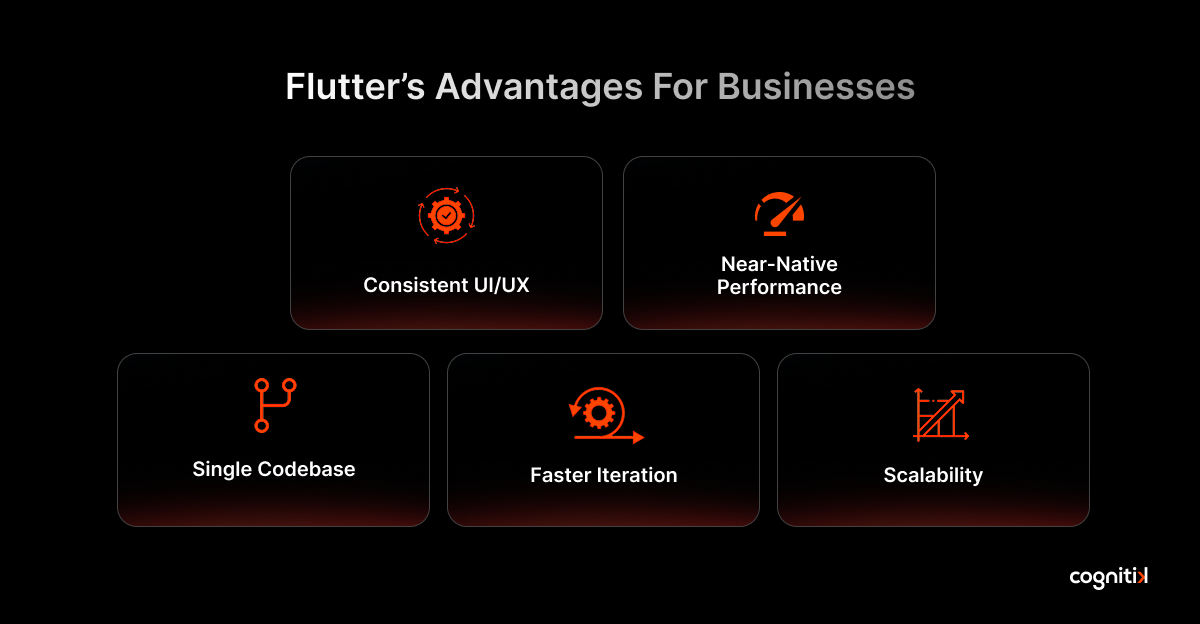
Flutter is an open-source UI framework created by Google. It uses the Dart programming language and builds its own user interface instead of depending on native platform components. Because of this, Flutter apps deliver consistent design and behavior across both iOS and Android. Businesses that care about smooth interactions, modern design, and performance often prefer Flutter for cross-platform mobile app development.
Many businesses choose cross-platform app development to save time and cost, but often face a new challenge later: inconsistent design, performance issues, or apps that feel different across devices. When user experience and visual quality matter, these problems can slow adoption and weaken brand trust. This is where Flutter app development becomes a strong option.
Key benefits of Flutter for businesses include:
- Near-native performance with fast load times and smooth animations
- A single codebase that speeds up development and reduces maintenance effort
- Consistent UI and user experience across platforms
- Faster iteration using hot reload during development
- Strong scalability for adding features as the product grows
Flutter works well for businesses planning long-term growth, design-focused apps, and feature-rich mobile experiences.
Understanding React Native Framework
Many companies want to launch mobile apps quickly but face challenges when mobile development feels unfamiliar or resource-heavy. Building separate iOS and Android apps often means higher costs, longer timelines, and added coordination between teams. For businesses that already have strong web development capabilities, this can feel inefficient. This is where React Native app development becomes a practical option.
React Native is a cross-platform framework created by Meta that allows businesses to build mobile apps using JavaScript and React. It relies on native UI components, which helps apps feel closer to platform-specific experiences while still sharing a single codebase. Teams with React web experience can transition into mobile development without starting from scratch.
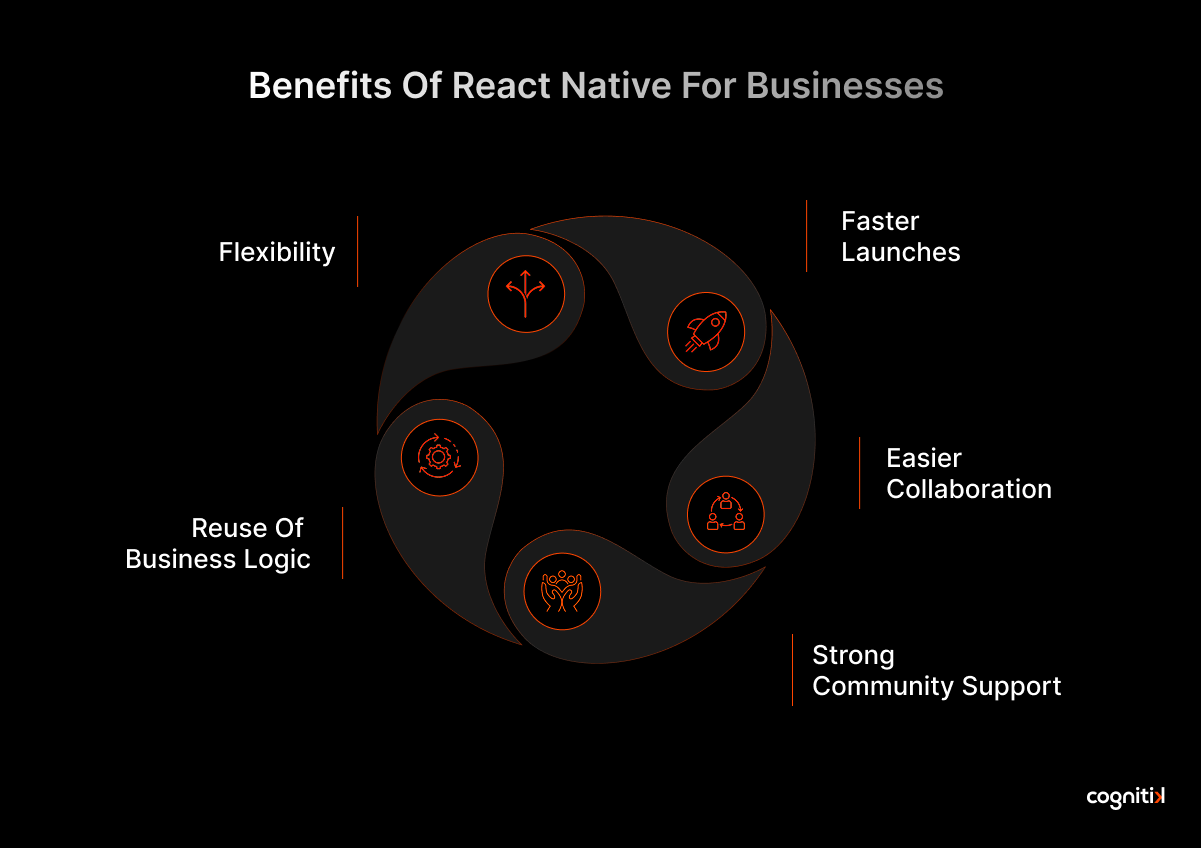
Key benefits of React Native for businesses include:
- Faster launches using existing JavaScript and React expertise
- Easier collaboration between web and mobile teams
- Strong community support with ready-to-use libraries and tools
- Reuse of business logic across web and mobile applications
- Flexibility to handle platform-specific features when required
React Native suits businesses that prioritize speed, adaptability, and continuous improvement without fully committing to native development.
Flutter vs React Native: Which Is Better for Business Growth?
When businesses compare Flutter vs React Native, the real concern is not the framework itself but how it supports growth, speed, and long-term stability. Decision-makers want to know which option delivers reliable performance, faster releases, controlled costs, and fewer limitations as the app scales. Looking at both frameworks from a business perspective helps clarify where each one truly fits and what trade-offs matter most over time.
1. Performance and user experience
Flutter controls its own rendering, which helps deliver smooth animations and consistent visuals across devices. This is useful for consumer-facing apps where design quality and interaction matter. React Native uses native components and a JavaScript bridge. Performance is strong for most business apps, though highly interactive or animation-heavy features may need extra optimization.
2. Development speed and time to market
React Native often allows faster launches when teams already work with React and JavaScript. This makes it practical for startups and MVPs. Flutter has a learning curve with Dart, but once teams adapt, development becomes efficient and predictable for long-term projects.
3. Cost considerations
Both frameworks help reduce costs compared to native development. React Native is often cheaper at the start because more developers are available. Flutter can save money in the long run since one consistent design works smoothly across platforms.
4. Scalability and maintenance
Flutter scales well as apps grow more complex. React Native also scales but may require additional native work over time. Planning maintenance early helps avoid surprises as usage increases.
The right choice ultimately depends on your business goals, team expertise, and long-term growth plans rather than just technical preferences. What works well for a fast launch may not always support future scale, and what feels complex early on may offer stronger stability later.
If you are evaluating Flutter vs React Native and want clarity based on your product vision, timelines, and growth strategy, getting guidance can make the decision easier. Get in touch with our experts at Cognitik to discuss your requirements and choose a cross-platform framework that aligns with your business needs and long-term goals.
Use Cases for Flutter and React Native
Many businesses struggle because they choose a framework based on popularity instead of how their product will actually grow over time. The right choice becomes clearer when you look at real use cases and working conditions, where business needs, team size, and long-term goals directly influence the decision.
- A startup launching an MVP usually focuses on speed, flexibility, and quick validation. With limited resources and a small team, the goal is to build a functional product fast and release it to the market. React Native app development supports this approach by allowing faster development cycles and easier iterations. Teams can quickly test ideas, gather user feedback, and refine features without investing heavily in the initial build. This makes it easier to validate demand before committing to long-term scaling.
- A growing eCommerce brand faces a different set of challenges. As product catalogs expand and user expectations increase, the focus shifts toward performance, smooth navigation, and consistent design across devices. Flutter app development becomes a strong choice in this stage because it enables fast page transitions, responsive interfaces, and visually consistent experiences. These factors directly impact user engagement and conversion rates, especially in competitive eCommerce environments.
- For enterprise applications, the decision becomes more strategic and complex. Businesses need to consider system integrations, security requirements, performance under heavy usage, and long-term maintenance. The comparison between Flutter and React Native is evaluated based on how well each framework fits into existing infrastructure and supports future scalability. In such cases, alignment with internal systems and long-term stability becomes more important than short-term development speed.
These scenarios highlight that choosing the right cross-platform framework depends on real business needs and growth plans, not just current trends or popularity.
Common Mistakes Businesses Make When Choosing a Framework
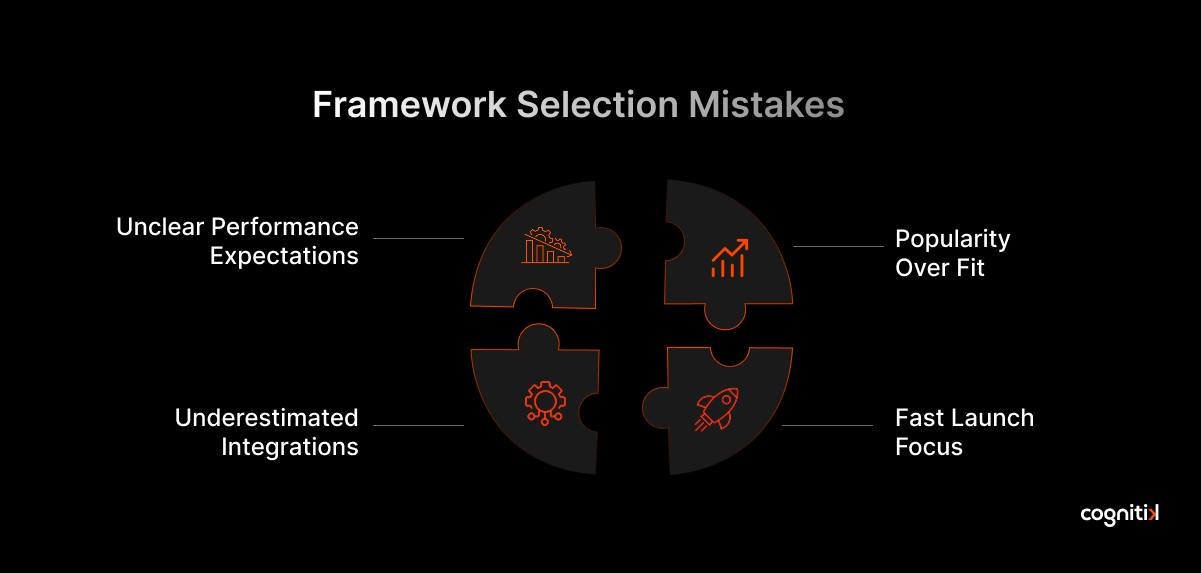
Many businesses struggle with app performance or rising costs because the framework decision is made too quickly, without fully understanding the long-term impact. This often creates problems that surface only after the product starts growing.
- Businesses often choose a cross-platform framework based on popularity or trends, not on how well it fits their product, users, or technical needs.
- Teams focus only on fast launch and ignore long-term maintenance, which leads to frequent fixes and higher costs as the app scales.
- Integration needs with APIs, analytics tools, payment systems, or internal software are underestimated, causing delays and rework later.
- Performance expectations are not clearly defined, resulting in apps that struggle as user traffic increases.
Choosing between Flutter and React Native should be driven by business priorities, scalability plans, and technical clarity. If you want expert guidance to avoid costly mistakes and choose the right cross-platform app development framework, connect with Cognitik specialists to plan a solution that supports long-term growth with confidence.
How to Choose the Right Framework for Your Business
Many businesses struggle with app delays or rising costs because the framework choice is made without a clear plan. What works at the idea stage may not support growth, performance, or maintenance later. Choosing the right cross-platform app development framework starts with clarity, not trends.
Begin by defining your business goals. Decide whether you are testing an MVP quickly or building a long-term product meant to scale. Next, review your team’s skills. Teams with React experience may lean toward React Native, while performance-focused apps may suit Flutter app development better. Then, evaluate future needs such as user growth, third-party integrations, and ongoing maintenance costs. Finally, consider user experience expectations across platforms.
When comparing Flutter vs React Native, the right choice is the one that aligns with your growth roadmap. Expert input can help businesses make confident, future-ready decisions.
How Cognitik Helps Businesses Choose the Right Cross-Platform Framework
Many businesses face delays, rework, or rising costs because the wrong cross-platform framework is chosen early. The decision is often rushed, based on popularity, or driven by short-term needs instead of long-term growth. This is where the right guidance makes a real difference.
At Cognitik, choosing between Flutter vs React Native starts with understanding the business, not just the technology.
- Business goals, target users, and product vision are reviewed to define clear technical needs.
- Performance expectations, scalability plans, and user experience priorities are assessed early.
- Integration requirements with APIs, analytics tools, and internal systems are carefully evaluated.
- Long-term maintenance, updates, and future expansion are planned before development begins.
Based on this analysis, Cognitik recommends the most suitable cross-platform app development framework and supports the full journey, from architecture design to ongoing optimization.
If you want clarity on which framework fits your product and growth plans, get in touch with Cognitik experts to make a confident, future-ready decision.
Final Thoughts
Choosing between Flutter and React Native is not about which framework is universally better. The real question is which one fits your business goals, growth plans, and user expectations. Many businesses struggle with delayed launches, high costs, or scaling challenges when the framework doesn’t match their needs.
Both Flutter and React Native offer cross-platform development, faster time to market, and cost efficiency. The key difference is in performance, scalability, and team expertise. Picking the right framework ensures smoother launches, easier maintenance, and long-term growth.
If you want expert guidance on selecting the best cross-platform framework for your mobile app, reach out to Cognitik experts today and get a solution tailored to your business vision and future expansion.
FAQs
Both Flutter and React Native support cross-platform app development, but the better choice depends on performance needs, scalability goals, and team expertise. Flutter suits performance-driven products, while React Native supports faster experimentation. Cognitik helps businesses evaluate frameworks based on growth stage and long-term plans.
Flutter works well for startups that want consistent UI, smooth performance, and future scalability. While the learning curve is slightly higher, it reduces redesign efforts later. Cognitik helps startups assess whether Flutter aligns with MVP speed requirements and long-term product evolution.
React Native is a strong fit when speed to market is a priority and teams already use React for web development. It supports rapid iteration and cost efficiency in the early stages. Cognitik evaluates team structure and delivery timelines to recommend React Native where flexibility and launch speed matter most.
Flutter offers strong scalability for complex UI and performance-heavy applications, while React Native scales well with careful architecture and native module planning. Cognitik designs scalable app architectures early, ensuring the chosen framework can support user growth without performance bottlenecks.
Cross-platform apps can deliver near-native performance when built correctly. Flutter handles rendering internally, while React Native depends on native bridges. Performance depends on architecture, not just framework choice. Cognitik optimizes performance regardless of framework by aligning technical decisions with real usage patterns.
React Native often has lower initial costs due to wider developer availability, while Flutter can reduce long-term UI maintenance costs. Total cost depends on features, scale, and updates. Cognitik helps businesses forecast both short-term and long-term costs before choosing a framework.
Switching frameworks later is possible, but often expensive without early planning. Poor architectural decisions can lead to rebuilds. Cognitik helps businesses plan framework choices with future flexibility in mind, reducing the risk of costly migrations as products scale.
React Native benefits from a mature ecosystem, while Flutter offers predictable UI behavior across platforms. Maintenance depends on code quality and structure. Cognitik provides long-term support, updates, and optimization services to ensure apps remain stable and scalable over time.
Enterprises often choose Flutter for performance consistency or React Native for faster internal tooling. The right choice depends on security, integrations, and scalability needs. Cognitik works closely with enterprises to align framework selection with compliance, performance, and operational requirements.
Cognitik starts with business goals, not frameworks. The team evaluates product vision, user expectations, performance needs, and growth plans before recommending Flutter or React Native. This ensures businesses invest in a cross-platform solution that supports sustainable growth.