

As a business grows, its website must handle more users, more features, and more integrations without slowing down. Many teams discover that what once worked well now creates delays. Adding a new feature affects unrelated pages. Connecting tools like CRMs or payment systems takes longer than expected. Even small updates feel risky.
These problems usually come from a tightly built web structure where everything is connected. When one part changes, multiple areas break or need rework. API-driven web development solves this by separating systems into independent components that communicate through APIs. This allows teams to add features, scale traffic, and integrate tools without rebuilding the entire platform.
In this blog, you will learn how API-driven web development supports faster business scaling, reduces technical friction, and helps companies build web applications that stay flexible as growth demands increase.
Understanding API-Driven Web Development
Many businesses struggle when their website needs to connect with more tools over time. Adding a payment gateway, CRM, analytics platform, or mobile app often creates delays, errors, or unexpected system issues. This usually happens because all parts of the website are tightly connected, making even small changes risky.
API-driven web development solves this by allowing different systems to communicate through APIs instead of being directly linked. An API acts as a secure bridge that lets the frontend, backend, and third-party services share data without depending on each other. This separation gives teams more flexibility and control.
For example, an eCommerce business can connect inventory, payments, shipping, and analytics through APIs. Each system can be updated or scaled independently. This approach supports scalable web development and helps businesses grow without rebuilding their entire platform.
Why Traditional Web Architecture Struggles as Businesses Grow
Many businesses choose traditional web development because it feels quick and easy at the start. Everything is built as one connected system, which works fine in the early stages but creates problems as the business grows.
- Feature updates take more time because even small changes affect the entire website.
- Adding new tools like CRMs, analytics, or payment systems requires heavy rework.
- Performance issues increase as traffic grows, making the site slower and less reliable.
- Fixing one issue often creates new bugs in other parts of the system.
- Scaling the platform becomes expensive because improvements feel like rebuilds.
For example, a growing SaaS business adding a new dashboard may need changes across multiple modules, delaying launches and increasing costs. These challenges show why traditional architecture struggles at scale and why API-driven web development becomes a smarter foundation for scalable web applications.
How API-Driven Architecture Supports Faster Business Growth
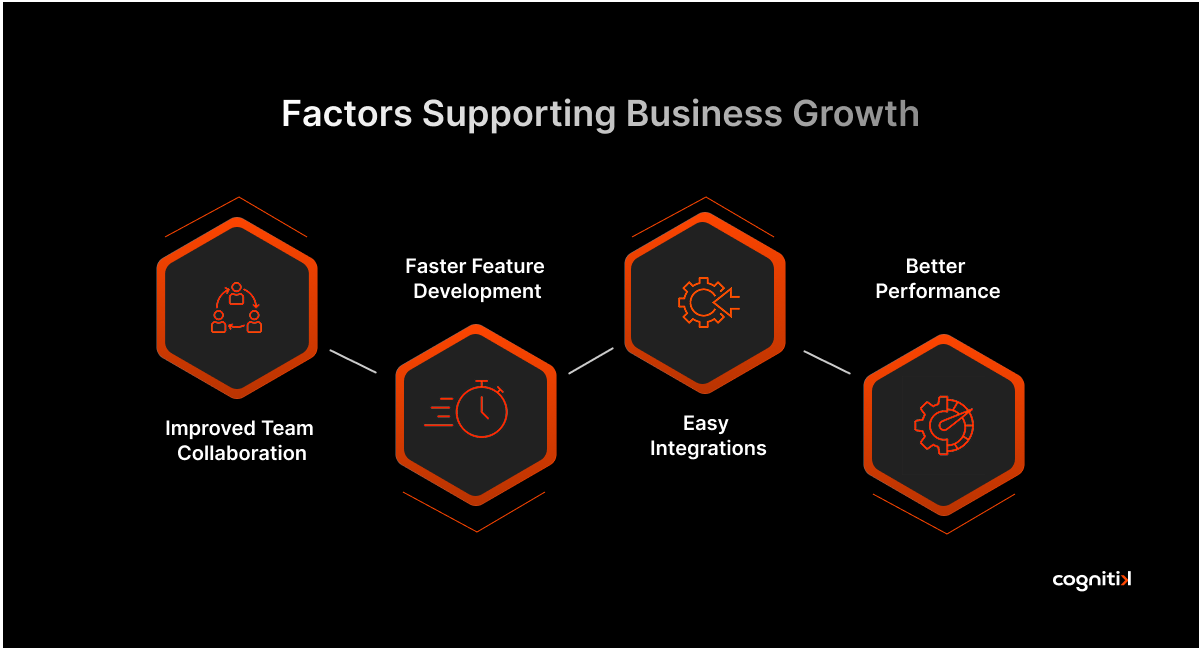
As businesses grow, speed becomes just as important as stability. Teams need to launch features faster, connect new tools without disruption, and handle more users without slowing down. This is where API-driven web development plays a key role in supporting consistent and scalable growth.
- Faster Feature Development: API-driven architecture allows different parts of a web application to work independently. Frontend and backend teams can build, test, and release features in parallel instead of waiting on each other. This reduces delays and helps businesses respond quickly to market needs.
- Easy Integrations: With API-based architecture, integrating third-party tools becomes much simpler. CRMs, payment gateways, analytics platforms, and internal systems can be connected through APIs without changing the core platform. This flexibility supports growth without constant rebuilding.
- Better Performance: API-driven systems distribute workloads across services instead of relying on one heavy system. This improves performance during traffic spikes and helps maintain a smooth user experience as demand increases.
- Improved Team Collaboration: Different teams can manage specific services or APIs, reducing dependencies and bottlenecks. This makes it easier to scale teams as the business expands.
If you want your web platform to grow faster without added complexity, connect with Cognitik experts to explore API-driven web development solutions built for long-term scalability.
Real-World Business Examples of API-Driven Web Development
As businesses grow, their web platforms are expected to handle more users, more features, and more integrations without slowing down. Many teams struggle because their systems were not designed to evolve easily. This is where API-driven web development proves its value by supporting growth at different business stages without constant rebuilding.
Startups Launching Faster
Startups often work with limited time and budgets, making speed a top priority. API-driven architecture allows them to quickly connect essential services such as payment gateways, user authentication, notifications, and analytics through ready-made APIs. Instead of building everything from scratch, teams can launch an MVP faster and validate ideas early. As the product matures, new features can be added without disrupting the existing system.
For example, companies like Stripe and Twilio provide ready-to-use APIs for payments and communication. Many startups integrate these services early to avoid building complex systems from scratch and to speed up their launch process.
Growing Businesses Expanding Services
As businesses scale, they often introduce mobile apps, partner dashboards, or region-specific platforms. With API-driven web development, all these platforms can use the same backend logic while delivering different user experiences. This ensures consistency while allowing flexibility across channels.
A strong example is Shopify, which uses APIs to power its ecosystem. Merchants can manage their stores through web dashboards, mobile apps, and third-party integrations, all connected through shared APIs. Similarly, Amazon uses APIs to support its marketplace, seller systems, and logistics operations at scale.
Enterprises Managing Complexity
Large organizations usually rely on multiple internal systems such as CRMs, ERPs, and reporting tools. API-driven architecture allows these systems to communicate securely while remaining independent. This reduces operational friction and makes it easier to scale without breaking existing workflows.
For example, Salesforce uses APIs extensively to integrate with various enterprise tools, enabling businesses to connect customer data, marketing systems, and analytics platforms. Companies like Netflix also rely on API-driven architecture to deliver content seamlessly across devices while managing complex backend services.
These real-world examples show how API-driven web development supports scalable web applications across every stage of business growth, from early startups to large enterprises.
Traditional vs API-Driven Web Development
As businesses grow, many realize that their websites and web applications start slowing them down instead of supporting progress. Simple updates take longer, new tools are hard to connect, and scaling feels risky. These challenges usually come from the way the web system was built. Understanding the difference between traditional web architecture and API-driven web development helps businesses choose a setup that can grow with them.
Traditional Web Architecture
Traditional web development connects the frontend, backend, and services into one tightly linked system. In the early stages, this feels simple and cost-effective. However, as traffic increases or new features are needed, small changes can impact the entire platform. For example, adding a new payment gateway or analytics tool may require major code changes, slowing releases and increasing costs.
API-Driven Web Development
API-driven web development separates systems and allows them to communicate through APIs. This modular approach makes it easier to add features, integrate third-party tools, or launch new platforms like mobile apps. For instance, an eCommerce business can update its checkout process or connect a new CRM without affecting the rest of the website. This flexibility supports scalable web development and reduces long-term risk.
For businesses planning steady growth, API-driven architecture offers a more reliable and future-ready foundation.
Key Benefits of API-Driven Web Development
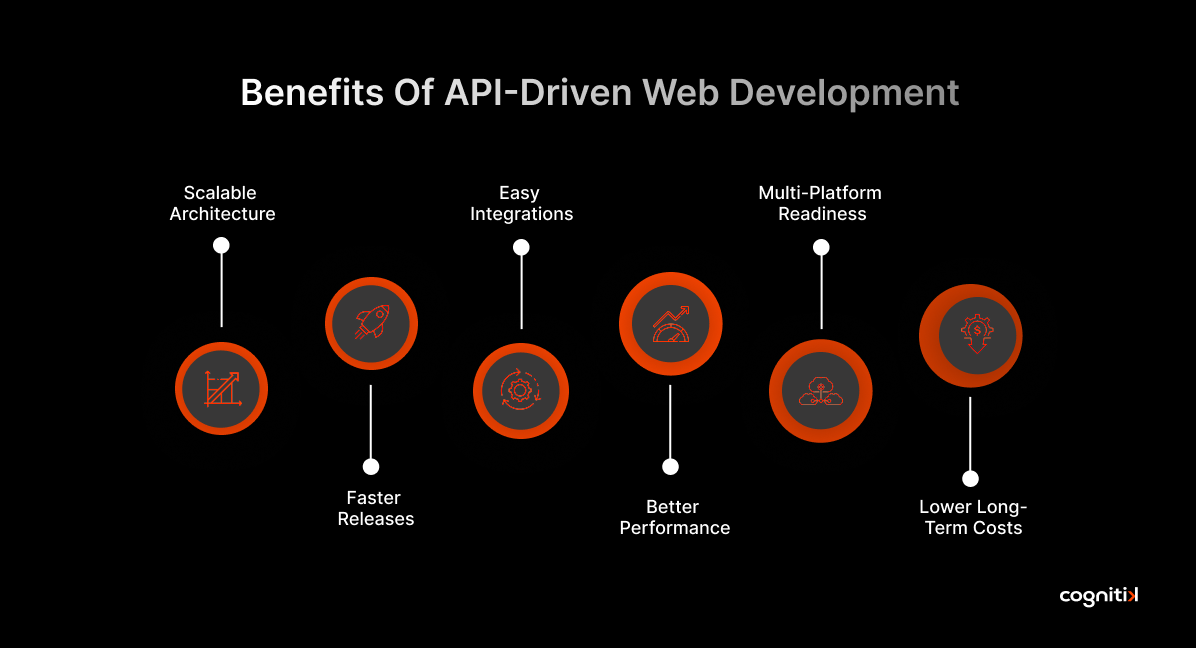
As businesses grow, their websites often face pressure from frequent updates, rising traffic, and new integrations. What once worked smoothly starts feeling rigid and expensive to maintain. API-driven web development addresses this challenge by creating flexible systems that scale without constant rebuilding.
- Scalable architecture: API-driven web development creates a flexible structure where different parts of the system work independently. As the business grows, new features, regions, or services can be added without disturbing what already works. This makes it easier to handle higher traffic, growing user bases, and changing business needs without repeated rebuilding.
- Faster releases: When frontend and backend systems are connected through APIs, teams are no longer dependent on each other for every update. Features can be built, tested, and launched in parallel. This shortens development cycles and helps businesses release improvements and updates at a much faster pace.
- Easy integrations: Modern businesses rely on multiple tools such as CRMs, payment gateways, analytics platforms, and marketing systems. APIs allow these tools to connect smoothly with the website without big changes to the core system. New integrations can be added or replaced as business requirements evolve.
- Better performance: API-based web architecture helps distribute workloads more efficiently across services. This reduces system strain during high traffic and prevents one issue from affecting the entire platform. The result is a more stable, reliable, and responsive user experience.
- Multi-platform readiness: The same set of APIs can support websites, mobile apps, dashboards, and future digital products. This allows businesses to expand across platforms without duplicating backend logic or rebuilding systems from scratch.
- Lower long-term costs: Because systems are modular and easier to maintain, businesses spend less time fixing issues and rebuilding features. Over time, this reduces development effort, maintenance costs, and operational risk.
These benefits make API-driven web development a smart foundation for sustainable business growth. If you want a web system that scales smoothly and stays future-ready, get in touch with experts at Cognitik, who can help you build the right API-driven solution with confidence.
Common Mistakes in API-Driven Web Development
Many businesses adopt API-driven web development to scale faster, but problems often appear when planning is rushed or incomplete. These challenges usually come from how APIs are implemented, not from the approach itself.
- Some teams build APIs without a clear business or growth roadmap, which leads to unused endpoints and systems that do not support future expansion.
- Poor or missing API documentation makes it hard for teams to maintain, update, or onboard new developers as the system grows.
- Overengineering at an early stage adds unnecessary complexity, slowing development and increasing maintenance costs without real value.
- Security is sometimes treated as an afterthought, creating data and access risks when more users and integrations are added.
API-driven development works best when it is aligned with real business goals, scalability plans, and long-term maintenance needs. With the right strategy, APIs become a foundation for growth instead of a source of technical debt.
How to Know If Your Business Needs API-Driven Web Development
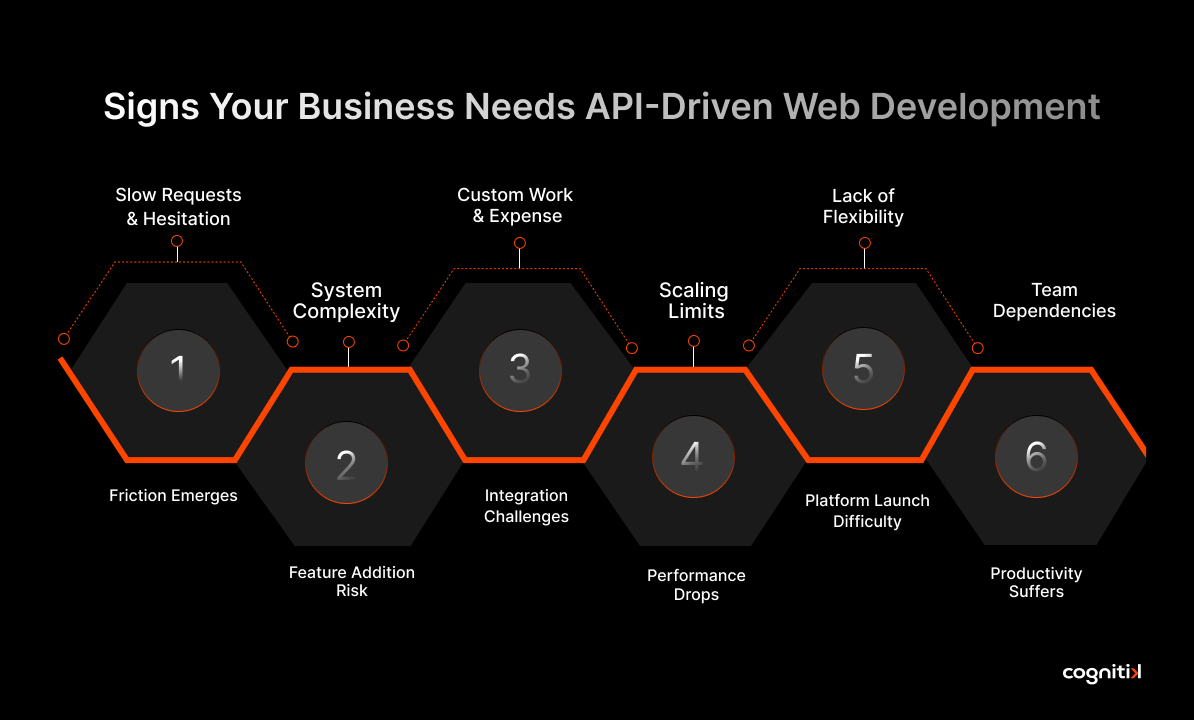
Most businesses don’t wake up one day and decide they need API-driven web development. The need usually becomes clear through everyday friction. Simple requests start taking longer. Teams hesitate before making changes. Growth plans feel harder to execute than expected.
Instead of looking for technical labels, it helps to look at how your systems behave in real situations:
- When adding a new feature requires touching many parts of the system, growth starts feeling risky.
- When every new tool or integration demands custom work, expansion becomes slow and expensive.
- When traffic increases and performance drops, the system shows its scaling limits.
- When launching a mobile app or new platform feels like starting from scratch, and flexibility is missing.
- When development teams wait on each other to make progress, productivity suffers.
These moments are not failures. They are signals that the current setup was built for a smaller stage of the business. API-driven web development addresses this by separating systems, enabling smoother integrations, and supporting scalable web applications that grow without constant restructuring.
This shift allows businesses to move forward with confidence, not caution.
How Cognitik Helps Businesses Build Scalable API-Driven Web Solutions
Many businesses know they need a more scalable web architecture, but struggle with where to begin or how to make the right technical decisions. Choosing APIs without a clear direction can create more complexity instead of solving real problems. This is where Cognitik’s approach makes a meaningful difference.
Cognitik starts by understanding the business before touching the technology. Teams take time to study growth goals, user journeys, operational challenges, and long-term plans. This clarity helps define what the system truly needs to support, not just what looks good on paper.
Next, existing systems and integrations are carefully evaluated. Whether it is legacy platforms, third-party tools, or performance limitations, Cognitik designs an API-driven architecture that fits the current setup while preparing for future expansion. Every API is structured to be secure, reusable, and well-documented, making future updates easier and safer.
During development, the focus remains on stability, performance, and flexibility. As the business evolves, Cognitik continues to support optimization, versioning, and system improvements to prevent costly rebuilds later.
If your business is planning to scale and needs clarity on building future-ready web systems, Cognitik helps you move forward with confidence and a clear technical roadmap.
Final Thoughts
Many businesses know they need a more scalable web architecture, but struggle with where to begin or how to make the right technical decisions. Choosing APIs without a clear direction can create more complexity instead of solving real problems. This is where Cognitik’s approach makes a meaningful difference.
Cognitik starts by understanding the business before touching the technology. Teams take time to study growth goals, user journeys, operational challenges, and long-term plans. This clarity helps define what the system truly needs to support, not just what looks good on paper.
Next, existing systems and integrations are carefully evaluated. Whether it is legacy platforms, third-party tools, or performance limitations, Cognitik designs an API-driven architecture that fits the current setup while preparing for future expansion. Every API is structured to be secure, reusable, and well-documented, making future updates easier and safer.
During development, the focus remains on stability, performance, and flexibility. As the business evolves, Cognitik continues to support optimization, versioning, and system improvements to prevent costly rebuilds later.
If your business is planning to scale and needs clarity on building future-ready web systems, Cognitik helps you move forward with confidence and a clear technical roadmap.
FAQs
API-driven web development is an approach where different systems communicate through APIs instead of being tightly connected. This allows websites, apps, and tools to share data easily, making the platform more flexible, scalable, and easier to update as business needs grow.
API-driven architecture allows teams to add features, integrate tools, and expand platforms without rebuilding the entire system. This reduces development delays, improves performance under high traffic, and supports faster product launches, which directly helps businesses scale more efficiently.
Yes, API-driven web development works well for startups and small businesses planning future growth. It allows quick integrations during early stages and supports expansion later. Starting with APIs helps avoid costly rework when traffic increases or new platforms are introduced.
Traditional web development tightly connects all system components, making changes risky and slow. API-driven web development separates systems using APIs, allowing independent updates, easier integrations, and better scalability. This approach supports long-term growth without frequent system rebuilds.
Businesses with growing user bases, multiple platforms, or frequent integrations benefit most from API-driven web development. This includes SaaS companies, eCommerce brands, marketplaces, and enterprises that rely on CRMs, ERPs, payment systems, or analytics tools.
When designed correctly, API-driven web applications are highly secure. Proper authentication, access controls, and encryption protect sensitive data. Working with experienced teams like Cognitik ensures APIs are built with security and compliance in mind from the start.
Cognitik helps businesses design, build, and scale API-driven web solutions based on real operational needs. From architecture planning to integrations and optimization, Cognitik ensures APIs support growth, performance, and long-term maintainability rather than limiting future expansion.