

Many businesses reach a point where growth starts to feel stuck, even though demand exists. Customers expect fast, reliable mobile experiences, but the app feels slow to build, costly to maintain, or difficult to scale. This is where one early decision quietly shapes everything that follows: choosing between native app development and cross-platform app development.
For growing companies, this choice directly affects time to market, user experience, development cost, and long-term scalability. The wrong approach can lead to performance issues, rising maintenance expenses, or complete rebuilds just when momentum matters most. The right approach can help you launch faster, engage users better, and scale with confidence.
This blog explains native vs cross-platform app development from a business-first perspective. You will learn how each approach supports scaling, where common mistakes happen, and how to choose an app development strategy aligned with real growth goals.
How Your App Development Strategy Affects Growth and Scale
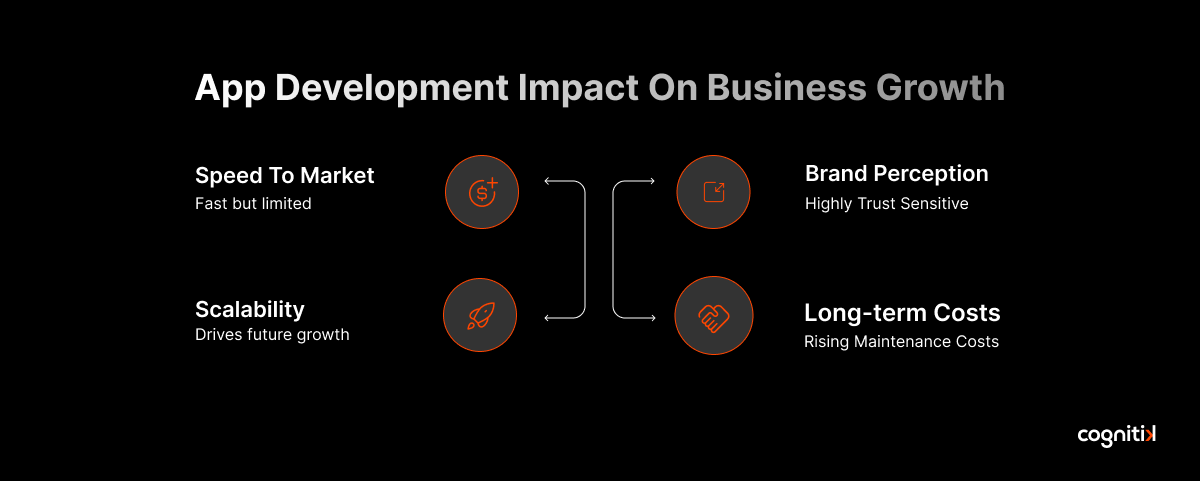
Many businesses approach app development as a build task, focusing only on features and timelines. In reality, the app development approach you choose directly shapes how your business grows, competes, and scales over time.
Your choice impacts:
- Speed to market: Startups launching a customer app often need to move fast. Cross-platform app development can help validate ideas quickly, while native app development may take longer but deliver stronger performance.
- Brand perception: A fintech or healthcare app that feels slow or unstable can reduce trust instantly, even if the service itself is strong.
- Scalability: Businesses adding new users, regions, or integrations often face limits if scalability was not planned early.
- Long-term costs: Apps that require frequent fixes or rewrites increase maintenance costs and slow growth.
For example, an ecommerce app that crashes during high traffic sales can lose revenue in minutes. In contrast, apps built with the right architecture support expansion without disruption.
If you want clarity on choosing between native vs cross-platform app development for scaling your business, connect with Cognitik experts to explore app strategies built for sustainable growth and performance.
A Clear Overview of Native App Development
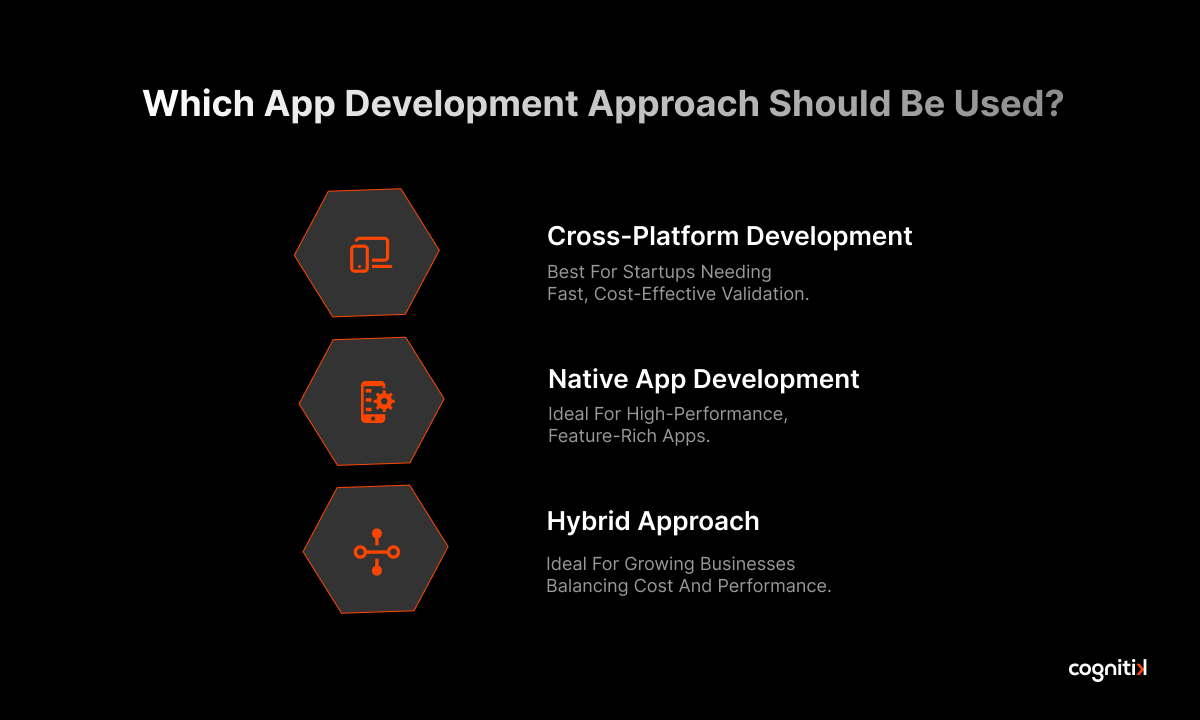
Native app development focuses on building separate applications for each platform, using Swift or Objective-C for iOS and Kotlin or Java for Android. Each app is designed to work directly with its operating system, which gives businesses greater control over performance, security, and user experience.
What native apps offer
Native apps deliver faster load times, smoother animations, and reliable performance even under heavy usage. They integrate seamlessly with device features such as cameras, GPS, biometrics, and offline storage, which is essential for apps that rely on real-time interactions.
When native development makes sense
Native app development is often the right choice for fintech platforms handling secure transactions, healthcare apps managing sensitive data, or logistics apps tracking live locations. These businesses need stability, compliance, and long-term scalability without compromise.
If your product demands high performance and future-ready architecture, connecting with Cognitik experts can help you evaluate native app development services aligned with your growth goals.
How Cross-Platform App Development Works
Cross-platform app development allows businesses to build one application that works on both iOS and Android using frameworks like Flutter, React Native, or Xamarin. Instead of managing two separate codebases, teams maintain a single shared foundation, which reduces development effort and speeds up delivery.
Why Businesses Choose Cross-Platform Apps
This approach is often chosen when speed and efficiency matter most:
- Faster launch timelines for new apps or features
- Lower initial development and maintenance costs
- Easier updates and a consistent user experience across platforms
- Faster testing and iteration cycles
Ideal Use Cases
Cross-platform app development works well for startups launching MVPs, businesses validating new ideas, internal dashboards, or customer-facing apps with moderate performance needs. For example, a retail brand testing a loyalty app or a service company launching a booking tool can enter the market faster without heavy upfront investment.
If you want clarity on whether cross-platform app development fits your growth plans, connect with Cognitik experts to explore cost-effective app development strategies aligned with your business goals.
Comparing Native and Cross-Platform Apps for Scaling Businesses
Choosing between native and cross-platform app development is not a technical debate. It is a business decision that affects speed, cost, user experience, and long-term scalability. The comparison below focuses on what truly matters to founders, product leaders, and growth teams.
Native vs Cross-Platform App Development Comparison
| Factor | Native App Development | Cross-Platform App Development |
| Performance | Excellent, highly optimized | Good, but depends on the framework |
| Development Speed | Slower (separate builds) | Faster (single codebase) |
| Initial Cost | Higher | Lower |
| Scalability | Strong for long-term growth | Moderate, improves with planning |
| User Experience | Platform-perfect UI/UX | Consistent across platforms |
| Maintenance | Separate updates for each platform | Easier maintenance |
| Access to Device Features | Full access | Limited or delayed access |
| Best For | High-performance, complex apps | MVPs, startups, faster launches |
What This Means for Businesses
A consumer fintech app handling real-time transactions benefits from native app development due to speed, security, and stability. In contrast, a startup testing a new service idea can launch faster with cross-platform app development and validate demand without heavy investment.
There is no universal best option. The right choice depends on growth goals, budget flexibility, performance expectations, and how quickly you need to enter the market.
If you want clarity on which app development approach aligns with your business roadmap, connect with Cognitik experts to plan a scalable app strategy built for real growth outcomes.
Real Business Scenarios Highlighting Native and Cross-Platform Choices
Scenario 1: Startup Testing Product-Market Fit
A tech startup with limited funding needed to validate its app idea quickly. They opted for cross-platform development to launch on both iOS and Android within weeks. This allowed them to gather real user feedback without overspending, adjust features based on demand, and prove concept viability before committing to a larger native build.
Scenario 2: Consumer App with High Daily Engagement
A fitness app serving thousands of daily users faced performance lags and crashes on peak usage. Choosing native app development allowed the team to optimize speed, responsiveness, and device-specific interactions. The result was improved retention, higher session times, and stronger user trust.
Scenario 3: Growing Business Expanding to New Regions
A regional e-commerce platform wanted to expand internationally while keeping costs manageable. They started with a cross-platform app for quick market entry. As usage grew, critical features like payment processing and AI recommendations were transitioned to native modules to handle complex traffic and enhance stability.
These scenarios show how strategic app development decisions, rather than trends, drive business growth. For guidance on choosing the right approach for your company, explore Cognitik’s mobile app development services tailored for scalable results.
Common Mistakes Businesses Make When Developing an App
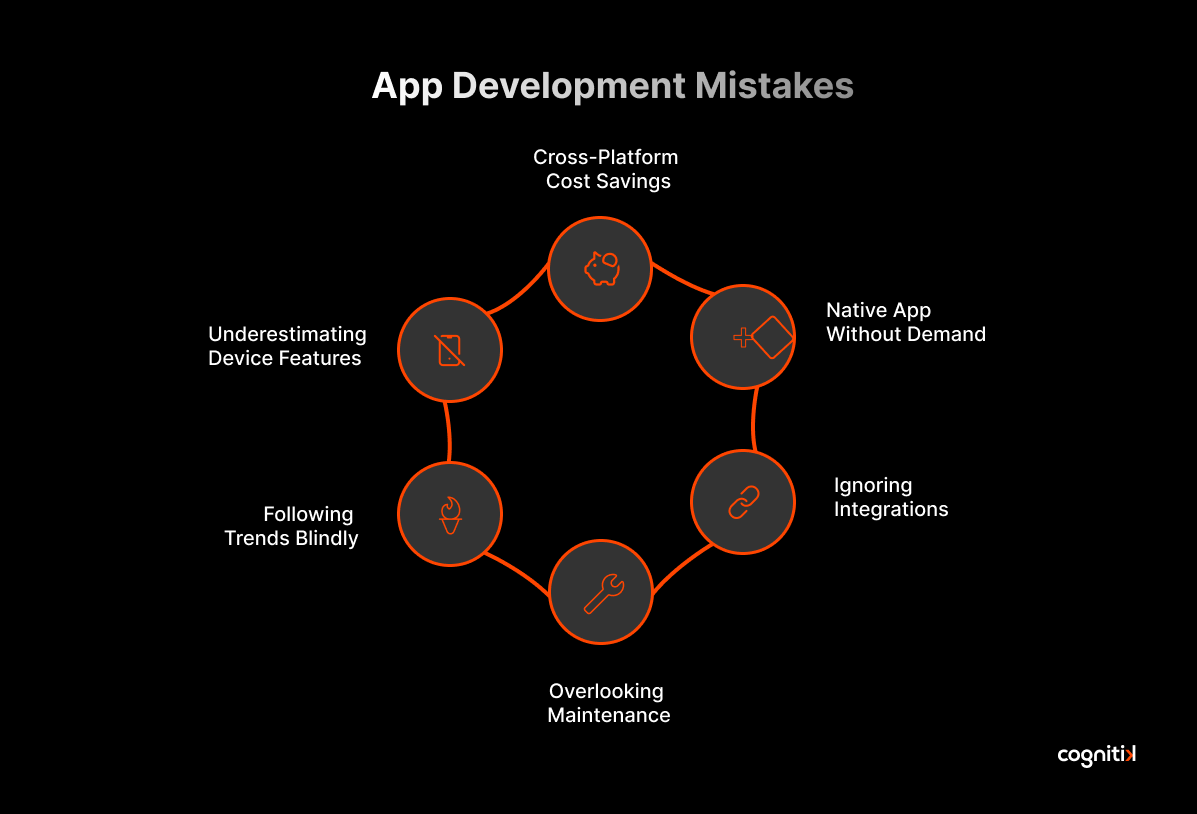
Many growth delays happen because of avoidable mistakes:
- Some businesses choose cross-platform development solely to save costs without evaluating whether the app can scale or perform efficiently in the long term.
- Others opt for native app development before validating market demand, which often leads to wasted time, effort, and investment.
- Ignoring future integrations with CRMs, ERPs, or analytics tools creates workflow bottlenecks and limits the app’s effectiveness.
- Overlooking ongoing maintenance, updates, and management of multiple platform versions can increase operational challenges.
- Following trends or copying competitors without analyzing the unique needs of your own user base can result in misaligned app strategies.
- Underestimating device-specific feature requirements, such as GPS, push notifications, or biometric authentication, can compromise user experience and functionality.
Avoiding these pitfalls requires a business-first app development strategy that balances speed, cost, and scalability.
If you want clarity on selecting the right app approach and avoiding common mistakes, get in touch with Cognitik experts to explore business-focused app development solutions.
How Cognitik Helps Businesses Scale with the Right App Strategy
Scaling with the right app strategy begins with understanding business goals, not just coding. Cognitik works closely with companies to evaluate whether native or cross-platform app development aligns with growth plans.
Our Approach:
- Analyze the business needs, market opportunities, and user behavior before selecting the appropriate app development platform.
- Compare native and cross-platform apps by evaluating factors such as speed, cost, and scalability to ensure the best fit.
- Design a scalable architecture that can support feature expansion and handle increasing user loads efficiently.
- Build apps optimized for performance, security, and discoverability to provide a reliable and high-quality user experience.
- Provide ongoing support for updates, integrations, and long-term growth to keep the app aligned with evolving business goals.
For example, startups testing MVPs, consumer apps handling high daily usage, and growing businesses entering new regions all benefit from this tailored strategy.
Final Thoughts
Choosing between native and cross-platform app development is ultimately a strategic growth decision, not just a technical choice. Startups testing product-market fit often benefit from cross-platform apps to launch quickly and validate demand.
High-traffic consumer apps or fintech platforms may require native development to ensure performance, stability, and security. Businesses that align their app approach with real growth goals can scale confidently, avoid costly rebuilds, and deliver seamless user experiences.
If you want a mobile app that supports fast growth and long-term success, get in touch with Cognitik experts to explore tailored app development strategies built for measurable results.
FAQs
Both native and cross-platform app development can support business scaling, depending on performance needs, budget, and growth plans. Cognitik helps businesses evaluate real usage scenarios, future scalability, and user expectations to recommend the right app development approach aligned with long-term business growth.
Cross-platform app development is ideal for startups and growing businesses seeking faster launches and lower initial costs. Cognitik builds scalable cross-platform apps that help businesses validate ideas quickly, gather real user feedback, and grow without early technical limitations or rushed rebuilds.
Native app development is best when performance, security, and advanced device features are critical. Cognitik supports businesses in fintech, healthcare, logistics, and enterprise domains by delivering stable, high-performing native apps designed to handle complex workflows and long-term scalability demands.
Yes, many businesses begin with cross-platform apps and transition to native as complexity increases. Cognitik plans this journey early by designing scalable architectures, reducing migration risks, and helping businesses avoid costly rebuilds when user demand, features, or performance expectations grow.
Cross-platform apps often lower short-term maintenance costs, while native apps offer better long-term stability. Cognitik helps businesses evaluate feature complexity, update frequency, and user growth to choose an app development strategy that balances maintenance costs with performance and scalability over time.
Cross-platform app development usually enables faster launches using a shared codebase across platforms. Cognitik helps startups and businesses release MVPs quickly while ensuring the app is structured for future growth, performance optimization, and smooth scaling as market demand increases.
Native apps deliver smoother performance and deeper device integration, while cross-platform apps ensure consistency across platforms. Cognitik designs user experiences based on app purpose and audience needs, ensuring the chosen development approach supports usability, engagement, and long-term user satisfaction.
Businesses should assess goals, target users, budget, scalability needs, security, and expansion plans. Cognitik follows a consultative app development approach, helping businesses make informed decisions that prevent technical debt and align app strategy with real-world growth objectives.