

Most businesses do not notice the problem right away. The website is live, pages open, and everything seems fine on the surface. Yet leads slow down, search rankings slip, and visitors leave without contacting you. Over time, the website quietly stops supporting growth and starts holding it back. This is usually when website redesign services become a business necessity rather than a visual upgrade.
For small and mid-sized businesses in the USA, a website plays a bigger role than ever before. It builds trust, supports SEO, guides visitors, and drives inquiries. When design, content, or structure no longer match user expectations, the gap shows in lost opportunities.
This blog helps you identify the clear signs your business needs a website redesign. It explains common issues businesses face, why they impact performance, and how a strategic website redesign can restore clarity, visibility, and consistent lead generation.
Key Reasons Why Businesses Need Website Redesign Services
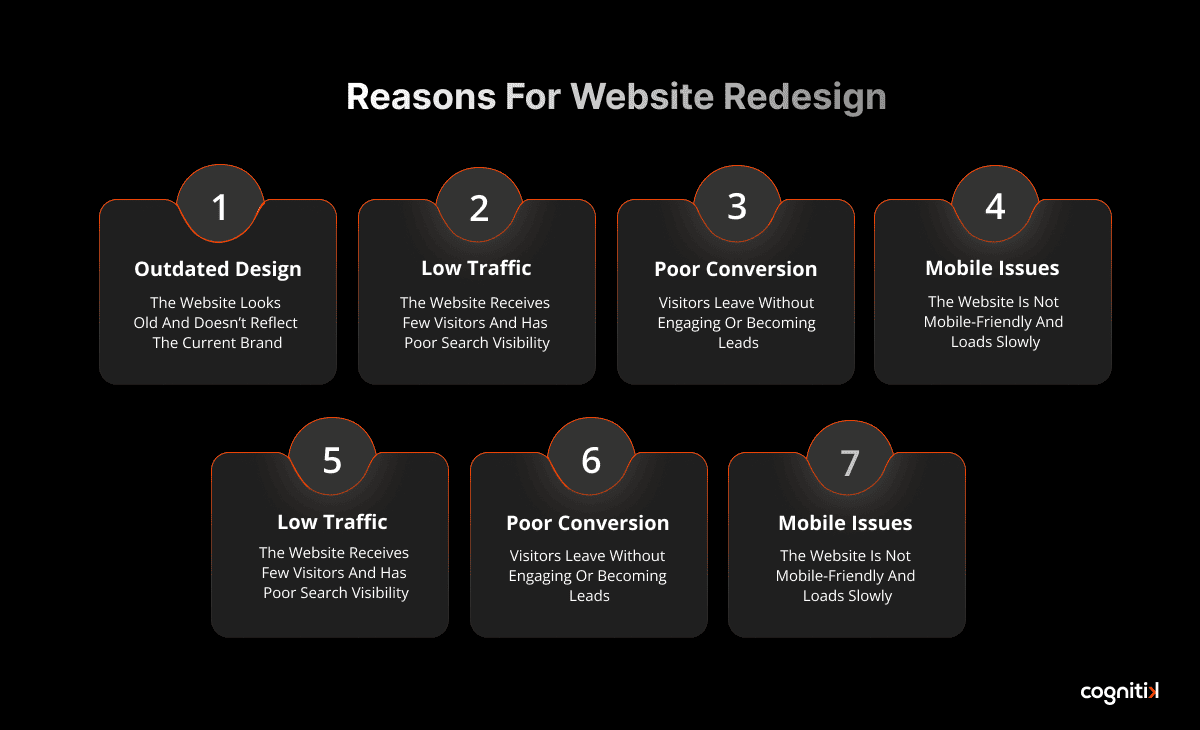
Website redesign services are rarely triggered by a single problem. In most cases, businesses notice a pattern of small issues that slowly begin to affect growth. What feels manageable at first often turns into missed leads, declining visibility, and lost trust.
Below are the most common and realistic reasons businesses decide it is time to redesign their website, based on real situations that many growing companies face:
1. Your Website Looks Outdated or No Longer Reflects Your Brand
Businesses evolve faster than websites. Services expand, messaging matures, and positioning shifts, but the website often stays frozen in an earlier phase. Fonts feel dated, layouts appear cluttered, and visuals no longer reflect the quality of work being delivered today.
Consider a consulting firm that serves enterprise clients but still presents itself like a small startup. Even if expertise has grown, the website sends the opposite signal. Visitors decide credibility within seconds, often before reading a single line of content. A brand-aligned website redesign updates visuals, tone, and structure so the website reflects where the business stands today, not where it started.
If your brand has grown but your website hasn’t, connect with our experts for professional website redesign services that rebuild trust from the first interaction.
2. Low Traffic or Declining Search Visibility
Many businesses experience a gradual drop in website traffic without a clear explanation. The content may still be relevant, but the structure, speed, or technical setup no longer aligns with modern search expectations.
Search engines prioritize mobile friendliness, fast loading times, clean navigation, and clear intent. Older websites often struggle with heavy code, unoptimized images, and poor content hierarchy. For example, a consulting or advisory firm may share valuable insights but remain hidden on Google due to technical SEO gaps, such as poor site architecture, unoptimized page speed, lack of schema markup, and weak internal linking.
An SEO focused website redesign improves site architecture, optimizes performance, and aligns pages with search behavior. This often leads to stronger rankings and more consistent organic traffic over time. Businesses looking to regain visibility often benefit from SEO driven website redesign strategies built for long-term growth.
3. Your Website Is Not Converting Visitors Into Leads
Traffic alone does not build a business. Many owners feel frustrated when visitors arrive but leave without contacting them. This usually points to unclear messaging, confusing navigation, or pages that explain services without addressing real outcomes.
For instance, a service-based business offering web development, consulting, or managed services may outline features instead of explaining benefits. Without clear problem-to-solution messaging, visitors struggle to understand why they should choose the business.
A conversion-focused website redesign reshapes content around clarity, trust, and action. It guides users naturally toward forms, calls, or consultations without pressure.
Businesses aiming to improve inquiries often explore conversion-ready website redesign services that turn visits into meaningful conversations.
4. Poor Mobile Experience or Slow Website Performance
Mobile traffic now dominates most industries. When a website loads slowly or feels difficult to navigate on a phone, users leave within seconds. Many older websites were not built with a mobile-first design in mind.
Buttons feel too small, text requires zooming, and pages load unevenly. A slow site not only frustrates users but also affects search rankings. A performance-optimized website redesign improves speed, responsiveness, and usability across all devices.
Businesses that rely on local searches or quick decision-making often see noticeable improvements after upgrading to a mobile-optimized website redesign built for real user behavior.
5. Your Business Has Grown, but the Website Has Not
Growth often creates complexity. New services, locations, or audiences get added to the website without restructuring. Over time, navigation becomes cluttered, and users struggle to find what matters most.
A company that started with one service may now offer multiple solutions, yet the homepage still treats everything equally. This creates confusion and limits scalability. A growth-focused website redesign reorganizes content into clear paths, making it easier for visitors to understand offerings and move forward.
Businesses planning expansion often benefit from scalable website redesign services that support future growth without constant rebuilding.
6. The Website Is Hard to Manage or Update
Many teams avoid updating their website because it feels complicated. Simple text changes require developer support. Launching new pages takes days instead of minutes. This slows marketing and creates unnecessary dependency.
A modern website redesign prioritizes usability for internal teams. Content management systems are simplified so updates feel manageable, even without technical expertise. This empowers businesses to keep content fresh and aligned with campaigns.
If managing your website feels stressful, a user-friendly website redesign can restore control and flexibility.
7. The Website Does Not Support Marketing Efforts
Marketing efforts often fail when the website cannot support them. Businesses invest in ads, email campaigns, or social promotions but lack proper landing pages, tracking, or integrations.
Without analytics, CRM connections, or clear conversion paths, results remain unclear. A strategic website redesign aligns the website with marketing goals. It supports tracking, integrations, and campaign-specific pages that improve performance.
For businesses looking to improve lead generation, marketing-ready website redesign services help connect strategy with execution.
If several of these situations feel familiar, it may be time to reassess how your website supports your business. Connect with Cognitik experts to gain clarity, identify gaps, and explore redesign solutions that strengthen visibility, trust, and lead generation in a way that feels practical and sustainable.
Hidden Costs of Delaying a Website Redesign
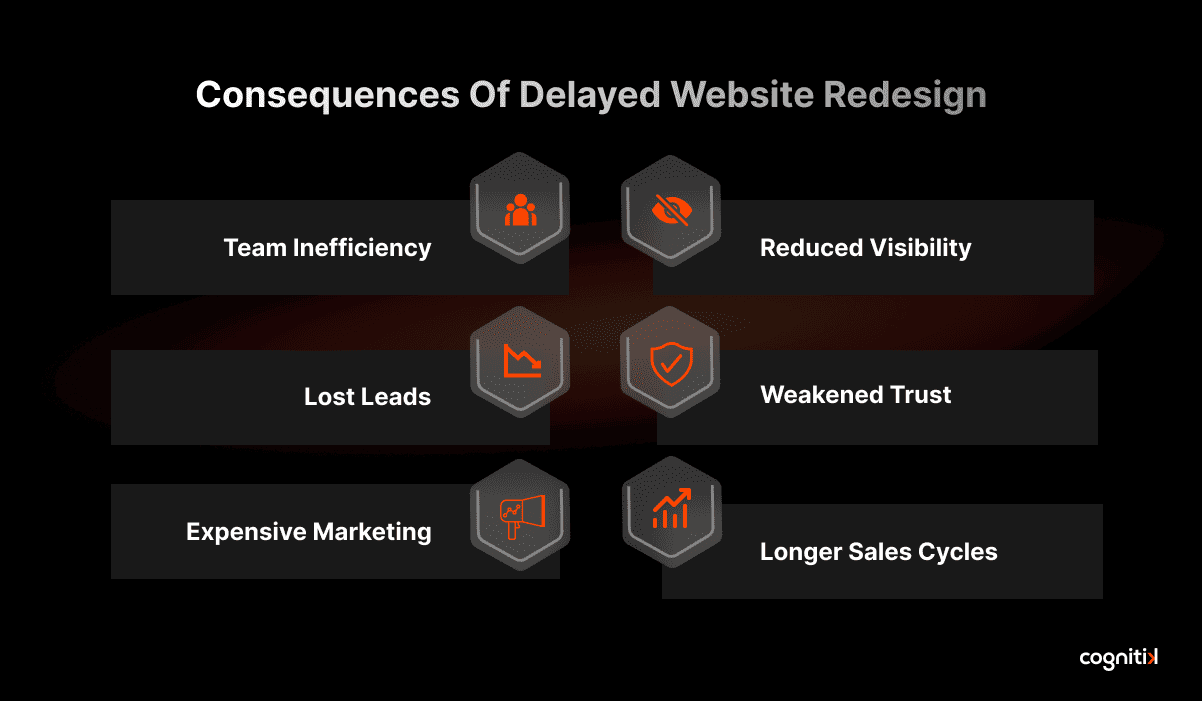
Many businesses delay website redesign because the site still works on the surface. However, the real cost builds quietly in the background and affects growth over time.
- Potential leads leave without contacting you because the website does not clearly guide them to take action.
- Paid marketing campaigns become expensive when landing pages fail to convert visitors into inquiries.
- Search visibility drops as outdated structure, slow speed, and weak technical SEO reduce rankings.
- Brand trust weakens when the website looks outdated compared to competitors offering similar services.
- Sales cycles become longer because visitors need more reassurance before reaching out.
- Teams lose time managing a website that is difficult to update or optimize
Over time, these issues force businesses to spend more money just to maintain the same results.
If you want clearer insight into how a strategic website redesign can protect revenue and support long-term growth, explore practical website redesign solutions with Cognitik experts who focus on measurable results.
How to Decide Between Redesigning or Rebuilding Your Website
Not every website issue requires starting over. The right approach depends on what is holding the site back and what the business expects from it in the future. Understanding the difference between a website redesign and a website rebuild helps set realistic expectations and prevents misaligned decisions.
When a website redesign makes sense
A website redesign is suitable when the platform is technically stable, but the experience feels outdated or unclear. This often applies to businesses whose branding, services, or audience have evolved.
For example, a consulting or professional services firm may have strong expertise and steady traffic, yet low inquiries because the messaging, layout, or mobile experience does not guide visitors clearly. A redesign improves structure, visuals, navigation, and conversion paths while keeping the existing system intact.
When a website rebuild is the better option
A website rebuild becomes necessary when the underlying technology limits performance, security, SEO, or scalability. Older platforms, heavy code, or poor mobile responsiveness can restrict growth. In such cases, rebuilding creates a cleaner, faster, and more flexible foundation that supports long-term business goals.
Knowing this difference helps businesses choose improvements that deliver lasting value rather than temporary fixes.
What Modern Businesses Should Expect from a Website Redesign
Not every website issue requires starting over. The right approach depends on what is holding the site back and what the business expects from it in the future. Understanding the difference between a website redesign and a website rebuild helps set realistic expectations and prevents misaligned decisions.
When a website redesign makes sense
A website redesign is suitable when the platform is technically stable, but the experience feels outdated or unclear. This often applies to businesses whose branding, services, or audience have evolved.
For example, a consulting or professional services firm may have strong expertise and steady traffic, yet low inquiries because the messaging, layout, or mobile experience does not guide visitors clearly. A redesign improves structure, visuals, navigation, and conversion paths while keeping the existing system intact.
When a website rebuild is the better option
A website rebuild becomes necessary when the underlying technology limits performance, security, SEO, or scalability. Older platforms, heavy code, or poor mobile responsiveness can restrict growth. In such cases, rebuilding creates a cleaner, faster, and more flexible foundation that supports long-term business goals.
Knowing this difference helps businesses choose improvements that deliver lasting value rather than temporary fixes.
What Modern Businesses Should Expect from a Website Redesign
A successful website redesign is not about making things look new. It is about making the website work better for real business goals, users, and growth.
- Clear user intent mapping: Pages should be designed around what visitors are actually looking for, whether it is services, pricing clarity, or next steps. This reduces confusion and drop-offs.
- SEO-ready structure: A clean site hierarchy, optimized URLs, and search-friendly content help improve visibility for website redesign services and related keywords.
- Focused messaging: Service pages should clearly explain problems solved, outcomes delivered, and why the business is the right choice.
- Mobile-first performance: Fast loading, responsive layouts, and easy navigation support both user experience and Google rankings.
- Strong conversion paths: Contact forms, calls to action, and lead points should feel natural and easy to access.
A business-focused website redesign aligns marketing, sales, and trust-building in one system.
To understand how this can work for your business, connect with Cognitik experts for practical website redesign guidance built around results.
Website Redesign That Supports Future Expansion
A strategic website redesign is more than a visual update; it lays the groundwork for sustained business growth. By improving SEO performance, optimizing conversion paths, and enhancing user experience, it ensures visitors engage meaningfully and become qualified leads.
A growth-focused redesign also supports expanding services, additional product pages, and content marketing initiatives. Marketing automation and CRM integrations can be implemented more effectively when the website structure is clear and scalable. This reduces friction for users and improves overall lead quality.
For example, a professional services firm that redesigned its website to align with growth goals saw higher organic traffic, more inquiries, and smoother content updates.
If you want to create a growth-ready website that evolves with your business, get in touch with Cognitik experts to explore website redesign solutions tailored for long-term results.
How Cognitik Approaches Website Redesign
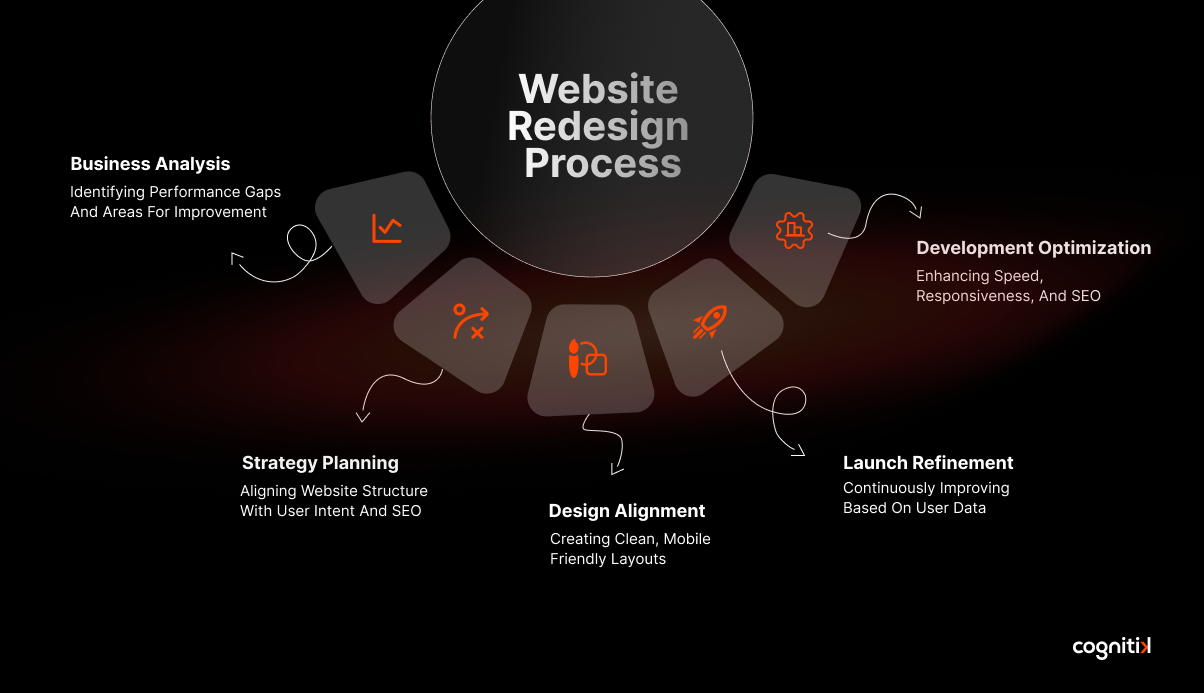
Cognitik follows a structured, business-focused website redesign process that prioritizes clarity, performance, and long-term results. Each step is handled carefully to ensure the redesigned website supports real business goals.
1. Business and Website Analysis
The process begins with business and website analysis. Existing pages, user behavior, traffic patterns, and conversion gaps are reviewed to understand what is limiting performance. This helps identify whether issues are related to structure, content, SEO, or usability.
2. Strategy and Planning
Now, based on findings, the website structure, page flow, and messaging are planned around user intent and search visibility. This ensures the redesign aligns with both customer expectations and SEO best practices.
3. Design and Content Alignment
The design and content alignment stage focuses on clean layouts, clear messaging, and mobile-friendly experiences. Content is refined so services, value, and next steps are easy to understand.
4. Development and Optimization
Then comes development and optimization, where speed, responsiveness, and SEO foundations are strengthened. Testing ensures smooth performance across devices.
5. Launch and Refinement
The launch is only the beginning. After going live, user behavior and performance data are reviewed to refine messaging, improve calls to action, and strengthen conversions. This ensures the website continues to adapt, perform, and support business growth over time.
If you want a website redesign that improves visibility, usability, and lead generation, connect with Cognitik experts to explore solutions built for measurable growth.
Final Thoughts
Website redesign is not about trends or aesthetics alone. It is about alignment. When your website reflects your business goals, supports users, and performs technically, growth becomes easier.
Understanding when your business needs website redesign services helps you act before missed opportunities pile up.
If clarity, performance, and lead generation matter, speaking with experienced professionals can simplify the decision.
Connect with our experts at Cognitik to plan a website redesign that supports real business outcomes and long-term success.
FAQs
How do I know if my business really needs website redesign services?
If your website gets traffic but few inquiries, loads slowly, looks outdated, or ranks poorly on Google, it is a strong sign. A strategic review with Cognitik experts helps identify whether redesign can restore performance and lead flow.
Will a website redesign help improve Google rankings?
Yes, website redesign services improve SEO by fixing structure, mobile responsiveness, page speed, and content clarity. Cognitik focuses on SEO-friendly redesign strategies that align with search intent, helping businesses regain visibility and organic traffic over time.
Is a website redesign better than building a new website from scratch?
It depends on the current website foundation. Some sites need structural improvement, while others need a fresh rebuild. Cognitik evaluates performance, scalability, and goals to recommend the most cost-effective and growth-ready solution.
How long does a professional website redesign usually take?
Most business website redesign projects take four to eight weeks, depending on size and complexity. Cognitik follows a clear, step-by-step process that minimizes disruption while ensuring SEO, performance, and conversion readiness are handled properly.
Can a website redesign really increase leads and conversions?
Yes. A redesign focused on user experience, messaging clarity, and calls to action helps guide visitors toward inquiries. Cognitik builds conversion-driven websites that reduce drop-offs and support consistent lead generation across channels.
Will my website content need to change during the redesign?
In most cases, yes. A redesign works best when content reflects current services, customer expectations, and search intent. Content is often refined to improve clarity, strengthen messaging, and guide visitors toward action. Cognitik supports content restructuring so the redesigned website communicates value clearly and supports better conversions.
How do I start planning the right website redesign for my business?
The first step is understanding what is not working and why. Speaking with Cognitik experts provides clarity on priorities, timelines, and outcomes, helping businesses move forward confidently with a redesign strategy that supports real growth.